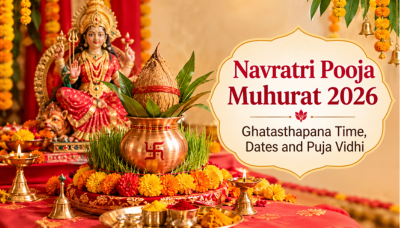
The Navratri Pooja Muhurat 2026 begins with Ghatasthapana on Sunday, 11 October, between 6:19 AM and 10:12 AM. Shardiya Navratri 2026 runs from 11 October to 19 October. Dussehra follows on Tuesday, 20 October.
The correct timing matters because tradition links the first prayer to the blessings of the whole festival. This guide covers the Navratri muhurat, the day-wise calendar, and the puja vidhi. All timings follow the Delhi Panchang, so check your local timings before you begin.
When Does Navratri Start in 2026?
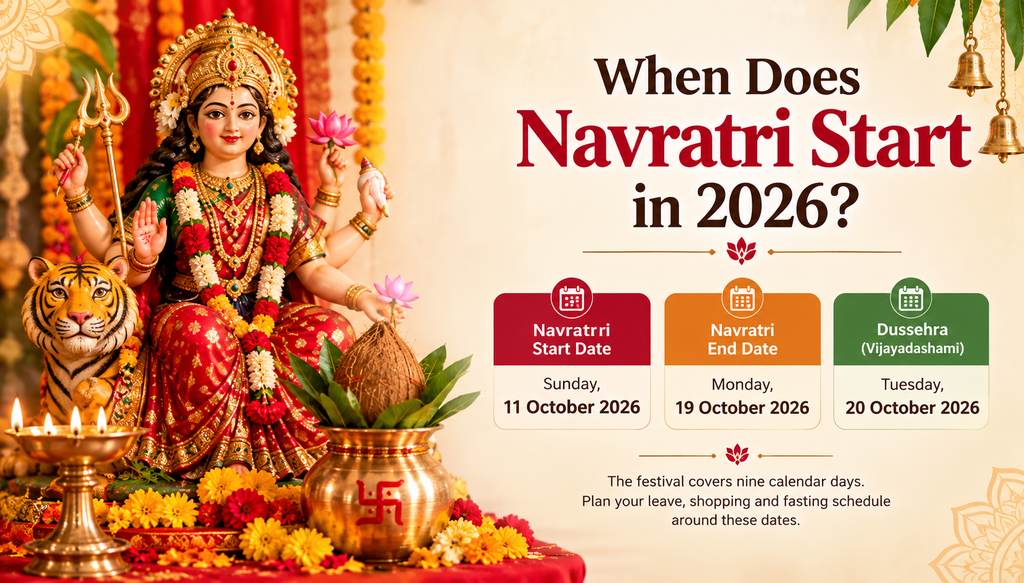
Navratri 2026 starts on Sunday, 11 October 2026. Devotees across India ask this question every year because the date depends on the Pratipada tithi.
- Navratri start date: Sunday, 11 October 2026
- Navratri end date: Monday, 19 October 2026
- Dussehra (Vijayadashami): Tuesday, 20 October 2026
The festival covers nine calendar days. Plan your leave, shopping, and fasting schedule around these dates.
What Is the Navratri Pooja Muhurat 2026?
The main Navratri Pooja Muhurat 2026 is the Ghatasthapana window on 11 October, from 6:19 AM to 10:12 AM. Two more timings matter later in the festival.
The Navratri shubh muhurat for Sandhi Puja falls on 19 October, between 10:27 AM and 11:15 AM. The Kanya Pujan timing also falls on 19 October, around 10:51 AM.
Many families ask for the Navratri puja time for daily prayers. Daily worship has no fixed muhurat, so most families pray in the morning after a bath. Therefore, the Navratri Pooja Muhurat 2026 mainly guides three events: Ghatasthapana, Sandhi Puja, and Kanya Pujan.
What Is the Ghatasthapana Muhurat 2026?
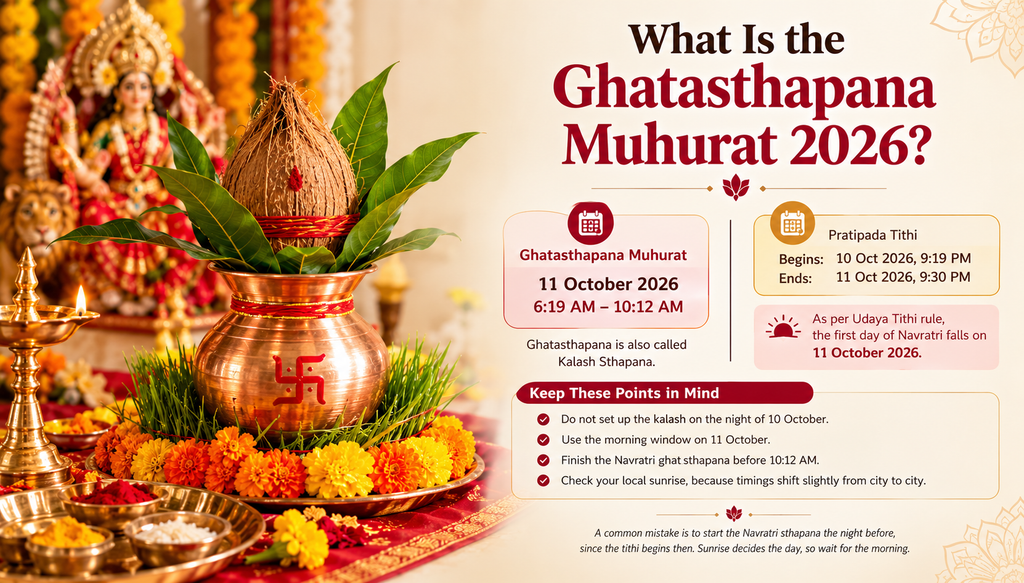
The Ghatasthapana muhurat on 11 October 2026 runs from 6:19 AM to 10:12 AM. Ghatasthapana is also called Kalash Sthapana. It marks the formal start of Navratri worship.
The Pratipada tithi begins on 10 October at 9:19 PM and ends on 11 October at 9:30 PM. However, the Udaya Tithi rule says the tithi at sunrise counts for the day. Therefore, the first day of Navratri falls on 11 October.
Keep these points in mind about the Navratri sthapana muhurat:
- Do not set up the kalash on the night of 10 October
- Use the morning window on 11 October
- Finish the Navratri ghat sthapana before 10:12 AM
- Check your local sunrise, because timings shift slightly from city to city
A common mistake is to start the Navratri sthapana the night before, since the tithi begins then. Sunrise decides the day, so wait for the morning.
Ask an astrologer for your exact Navratri sthapana time. You can try the free astrology chat on KundliChat for help with local timings.
What Is the Navratri 2026 Day-Wise Calendar?
Each day of Navratri honors one form of Maa Durga and carries one lucky color. The table below lists all days for 2026.
| Date | Day | Goddess | Colour |
| 11 Oct | Sunday | Maa Shailputri (Ghatasthapana) | Orange |
| 12 Oct | Monday | Maa Brahmacharini | White |
| 13 Oct | Tuesday | Maa Chandraghanta | Red |
| 14 Oct | Wednesday | Maa Kushmanda | Royal Blue |
| 15 Oct | Thursday | Maa Skandamata | Yellow |
| 16 Oct | Friday | Maa Katyayani (Durga Puja begins) | Green |
| 17 Oct | Saturday | Maa Kalaratri | Grey |
| 18 Oct | Sunday | Maa Mahagauri | Purple |
| 19 Oct | Monday | Durga Ashtami and Maha Navami | Peacock Green |
| 20 Oct | Tuesday | Vijayadashami and Durga Visarjan | As you wish |
Wearing the daily color is a popular custom. It is optional, but many families follow it.
When Are Ashtami and Navami in 2026?
Both Ashtami and Navami fall on Monday, 19 October 2026, according to the Delhi Panchang. This happens when two tithis overlap on one day.
The day includes three key events:
- Sandhi Puja: 10:27 AM to 11:15 AM
- Kanya Pujan for Ashtami: before 10:51 AM
- Kanya Pujan for Navami: after 10:51 AM
So follow your family custom. If you observe Ashtami, hold Kanya Pujan in the morning before 10:51 AM. If you observe Navami, hold it afterward.
How Do You Perform Ghatasthapana During Navratri?
You perform Ghatasthapana by placing a filled kalash on a bed of soil and barley during the morning muhurat. Follow these steps:
- Clean the puja area and spread a fresh cloth.
- Prepare a clay or copper kalash and fill it with clean water.
- Spread soil on a plate and sow barley seeds.
- Set the kalash on the soil, then add mango leaves and a coconut wrapped in red cloth.
- Invoke Maa Durga with a short prayer and a clear intention.
- Light a diya near the kalash.
- Begin daily prayers each morning and evening.
Water the barley lightly each day. Healthy green shoots by Ashtami are seen as a good sign.
Which Vahan Will Maa Durga Use in Navratri 2026?
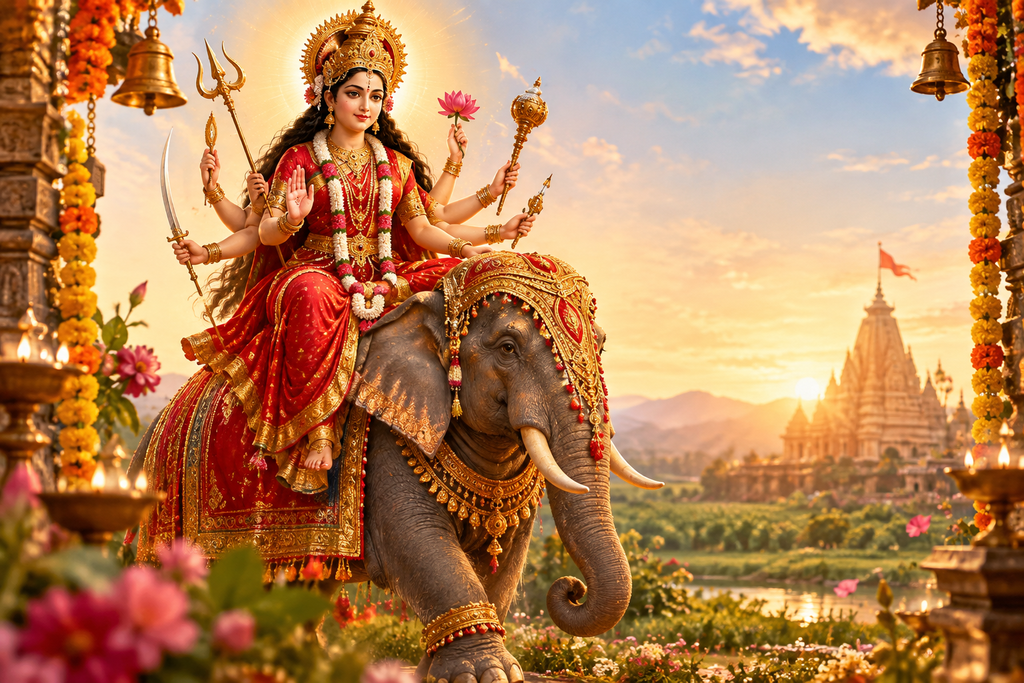
Maa Durga is believed to arrive on an elephant this year. Tradition says her vahan depends on the weekday when Navratri begins, and this Navratri starts on Sunday.
The elephant is a symbol of good rainfall and a rich harvest. Therefore, devotees see this arrival as a sign of prosperity and peace.
Beliefs differ by region and Panchang, so treat this as a traditional view.
What Are the Navratri Puja Rules to Follow?
Follow a simple, clean, and respectful routine for all nine days. These rules apply in most households:
- Avoid onion and garlic in all meals
- Stay away from non-vegetarian food
- Do not drink alcohol
- Keep the Akhand Jyoti burning and refill the oil or ghee on time
- Respect the women and girls of your home
- Keep your home and puja space clean
- Fast and pray as your health and family custom allow
Anyone with a health condition should adjust the fast. Devotion matters more than strict rules.
Why Is Navratri Celebrated?
Navratri celebrates the victory of Maa Durga over the demon Mahishasura. According to the Devi Mahatmya, she fought him for nine days and defeated him on the tenth.
That tenth day is Vijayadashami, also called Dussehra. It also marks the day Lord Rama defeated Ravana. Lord Rama is said to have prayed to Maa Durga before the battle.
Both stories carry one message: good wins over evil.
Frequently Asked Questions About Navratri 2026
1. When does Navratri start in 2026?
Shardiya Navratri starts on Sunday, 11 October 2026, and ends on 19 October.
2. What is the Navratri Pooja Muhurat 2026?
The main muhurat is the Ghatasthapana window on 11 October, from 6:19 AM to 10:12 AM.
3. What is the Ghatasthapana muhurat in 2026?
It runs from 6:19 AM to 10:12 AM on 11 October, based on the Delhi Panchang.
4. Can I do Ghatasthapana on the night of 10 October?
No. The Udaya Tithi rule makes 11 October the first day, so use the morning muhurat.
5. When are Ashtami and Navami in 2026?
Both fall on Monday, 19 October 2026.
6. When is Dussehra in 2026?
Dussehra falls on Tuesday, 20 October 2026.
Conclusion
Navratri 2026 runs from 11 October to 19 October, and Dussehra follows on 20 October. The Ghatasthapana muhurat of 6:19 AM to 10:12 AM on 11 October is the most important timing. Confirm your local timings, plan your puja items early, and begin each day with a calm mind.
Stay updated with astrology tips and useful guidance by following KundliChat on Facebook now.